
How to Increase Brand Awareness
Posted by Clash Printing Atlanta on 19th Aug 2026
If your target audience doesn't know your brand exists, they can't buy from you. It's exactly that simple, and exactly that difficult to fix. Whether you're launching a new product, entering a fresh market, or trying to stand out in a crowded category, learning how to increase brand awareness is one of the highest-leverage investments you can make. This guide walks you through the foundations of a brand awareness strategy, proven strategies across content, social, search, and offline channels, plus a practical framework for measuring what's working.
Key Takeaways
Brand awareness directly impacts revenue. Businesses with consistent brand presentation experience revenue lifts of 10–20% on average, and brands with high awareness are likely to generate more sales because products become more recognizable to consumers. These aren't abstract gains. They translate into lower customer acquisition costs, stronger pricing power, and resilience during economic downturns.
Building awareness starts before the first campaign. You need a clear brand strategy (values, positioning, visual identity) executed consistently across content marketing, social media channels, search engines, and offline touchpoints. Color alone can boost brand recognition by up to 80%, and companies with strong branding see 50% more job applicants. That's the breadth of what awareness touches.
Measurement is non-negotiable. Surveys, branded search volume, social share of voice, and direct traffic tell you whether your marketing efforts are translating into real awareness or just noise. Without data, you can't defend budgets or improve campaigns.
This article covers everything from defining brand awareness and clarifying your brand values, through actionable channel-by-channel tactics, to a measurement framework you can implement this quarter.
What Is Brand Awareness and Why Brand Awareness Matters
Brand awareness refers to how easily your target audience recognizes and recalls your brand-its name, logo, values, and products-in real buying situations. There are two dimensions here. Recognition means a consumer can identify your brand when they see it. Brand recall goes further: it's when people can name your brand unprompted in a product category. If someone thinks "running shoes" and immediately thinks of Nike, that's recall.
But brand awareness goes beyond just a logo. It includes understanding what the brand does and what it stands for. Patagonia is synonymous with environmental sustainability. Tesla means electric innovation. These associations matter because 58% of consumers buy brands based on shared values.
Why does brand awareness matter at the top of the funnel? People rarely consider brands they've never heard of, especially in crowded B2C and B2B categories. If your brand isn't in the consideration set, your conversion rate on everything downstream-ads, landing pages, sales calls-suffers.
The tangible outcomes are significant. Strong brand awareness leads to improved conversion rates, reduced customer acquisition cost, and the ability to charge premium prices. Brands with consistent presentation can charge roughly 22% price premiums over less consistent competitors. Brand loyalty leads consumers to pay more for trusted brands, and that loyalty creates a buffer during downturns.
Brand awareness is one component of brand equity, alongside perceived quality, brand image, and customer loyalty. It's distinct from brand identity (how you want to present yourself) or brand image (how others actually perceive you). For startups and scale-ups, early investment in building awareness lays the foundation for later performance marketing and sales efficiency. Your paid campaigns will simply work better when people already know who you are.
How Brand Awareness Gives You a Competitive Edge
Consider two scenarios. You're choosing a new project management tool for your team: you've heard of Asana and Monday.com, but a startup called "TaskFlowPro" also appears. Most people default to the familiar names, even if feature sets are comparable. Or imagine buying running shoes: Nike, OnCloud, or Hoka come to mind instantly. A smaller brand with equivalent specs struggles to get considered. Brands with high awareness are likely to generate more sales simply because they're top-of-mind.
This is mental availability. Coca-Cola in soft drinks, Adobe in creative software-these iconic brands occupy category-defining positions in consumer minds. That mental real estate is a moat. When new entrants or copycats appear, strong brand awareness cushions the blow because consumers default to what they know. Competitors must spend disproportionately to displace you.
Brand awareness also shapes employer branding. Companies with strong branding can see 50% more job applicants, and 75% of job applicants consider the brand before applying. In tight talent markets (tech, biotech, AI), that's a tangible advantage.
Finally, high brand awareness interacts with performance channels. Search ads for recognized brands have higher click-through rates. Social ads featuring familiar visuals produce better recall. Brand awareness increases sales by making products more recognizable, which shortens the customer journey and improves overall marketing ROI.
Clarifying Your Brand Strategy and Brand Values Before You Scale Awareness

Successful brand awareness campaigns start with a clear brand strategy, not just a logo and a color palette. Before you spend a dollar on advertising or create a single social media post, you need to establish a unique value proposition to stand out from competitors.
Start by defining your target market segments and their needs. Who are you serving? What problems do you solve that competitors don't? This is your positioning. It should be specific enough that when someone in your target audience hears your brand messaging, they immediately understand why you're relevant to them.
Next, articulate 3–5 core brand values, like transparency, innovation, or sustainability, that guide both your external communications and internal decisions. These values become the backbone of your brand voice and shape every piece of content, every customer interaction, and every hiring decision. A strong brand identity can increase customer loyalty because people gravitate toward brands whose principles match their own.
Then build your visual identity system:
-
Logo: Primary and secondary lockups for different contexts
-
Typography: Headline and body fonts
-
Color palette: Primary and secondary colors (remember, consumers are 81% more likely to remember company colors)
-
Imagery style: Photography approach, illustration guidelines
-
Tone of voice: How you speak-formal, conversational, playful, authoritative
Document all of this in a simple brand guidelines document before investing heavily in campaigns. Consistent messaging helps customers quickly recognize a brand, and that recognition is what makes every subsequent marketing effort more effective.
While branding and marketing are related and often overlap, each has a specific function, but together they form the backbone of your brand strategy.
Creating a Consistent and Memorable Brand Presence
Consistency across channels can increase brand recognition by up to 80%. That number isn't surprising when you consider how memory works. Every time someone encounters your brand-same colors, same tone, same logo placement-you're reinforcing a neural pathway. Fragmented branding forces the brain to start over each time.
What does consistency look like in practice? It means the same logo usage, color scheme, and tone across emails, social media channels, packaging, presentations, and offline collateral. Apple's minimalist design language is identical whether you're unboxing a product, browsing their website, or watching a keynote. Nike's bold typography and athlete-driven imagery are instantly recognizable, whether on a billboard or an Instagram story.
Consider how Eternal Water maintained a unified wellness tone across its influencer campaigns on TikTok and Instagram, hitting 45.9 million views while keeping CPMs under $10. That consistency of aesthetic and message is what made the brand feel cohesive to new audiences.
The risk of fragmentation is real. When different teams or agencies improvise visuals or messaging, the brand dilutes. Combat this with brand templates, asset libraries, and simple QA checklists.
Quick consistency checklist:
-
Logo lockups (horizontal, stacked, icon-only)
-
Approved fonts for headlines and body
-
Color codes (HEX, RGB, CMYK)
-
Photography style rules
-
CTA button styles
-
Social media response tone
Building Brand Awareness Through Content Marketing and Storytelling
Content marketing is one of the most cost-effective long-term marketing strategies for creating brand awareness. Unlike paid ads that stop working when the budget runs out, content compounds. A well-written blog post can rank in search engines for years, continuously introducing potential customers to your brand. Content marketing enhances visibility and trust in a crowded market, and high-quality content positions a brand as an industry leader.
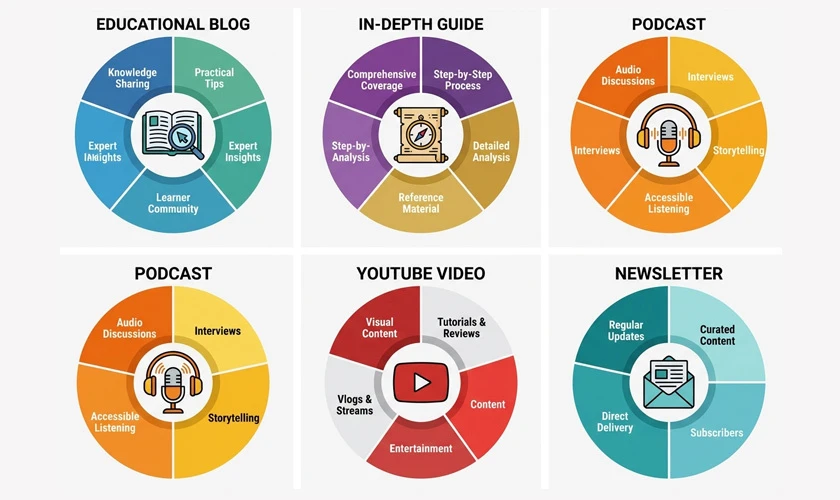
Core content formats that support awareness include:
-
Educational blog posts that cover industry insights and problem-solving tips
-
In-depth guides and downloadable resources
-
Podcasts and webinars for deeper engagement
-
YouTube videos and short-form clips
-
Newsletters that keep your brand in inboxes consistently
Storytelling in content marketing enhances emotional connections with audiences. Tell your origin story, share your mission, highlight challenges you've overcome, and publish customer success stories that communicate brand values without heavy selling. Content that helps audiences build familiarity and trust over time, and consistent content creation fuels SEO efforts and keeps websites relevant.
Content marketing builds trust with potential customers and helps establish authority and drive organic traffic. For instance, a telecom brand working with iCrossing built SEO content hubs that captured non-branded demand, driving an 800%+ non-branded traffic surge and a 17% increase in total order volume. Huntress, a cybersecurity firm, shifted from 97% branded traffic to about 74% non-branded via a content strategy, dramatically expanding discovery among new audiences.
Publish high-value content consistently to position your brand as an authority, and repurpose across channels: a webinar becomes clips, a blog post, email snippets, and social media posts.
Leveraging Social Media Channels and Social Media Contests
Social media remains central to brand awareness because of massive daily usage, algorithmic discovery, and low production barriers. Social media users spend over two hours daily as of 2024, which makes these platforms prime territory for getting your brand noticed.
Selecting specific social media platforms can optimize resource allocation. Here's a rough guide:
|
Platform |
Best For |
Content Style |
|---|---|---|
|
TikTok |
Gen Z, younger millennials |
Short-form video, trends |
|
|
Lifestyle, DTC, visual brands |
Reels, Stories, UGC |
|
|
B2B, thought leadership |
Articles, carousels, commentary |
|
YouTube |
Tutorials, long-form education |
How-to videos, brand documentaries |
Build a recognizable social presence with consistent profile images, bios that reflect brand values, and a balanced content mix: education, entertainment, behind-the-scenes, and user-generated content. Community-driven social media content enhances brand visibility.
Social media contests and giveaways are a simple way to spread awareness. Tag-a-friend contests, branded hashtag challenges, and UGC campaigns encourage sharing and expand reach to new audiences. Brands should run polls and Q&A sessions to enhance engagement, and responding to comments fosters community and increases engagement.
Maintain an optimized presence across key social media platforms and use native analytics tools (Meta Business Suite, TikTok Analytics, LinkedIn analytics) to monitor reach, social media engagement, and follower growth. Engaging with followers increases brand loyalty and trust, turning casual viewers into advocates. Interactive storytelling boosts engagement by involving audiences directly in the brand narrative.
Boosting Brand Visibility with Search Engines and SEO
Search engine optimization drives both direct traffic and indirect brand awareness. Even when users don't click your result, appearing prominently in search engines like Google and Bing puts your brand name in front of potential customers repeatedly.
Basic SEO steps to improve brand awareness:
-
Keyword research: Identify relevant keywords-both informational queries your audience searches and branded terms
-
On-page optimization: Titles, meta descriptions, H1 headings, and internal links
-
Technical hygiene: Site speed, mobile-friendliness, crawlability
-
Content creation: Answer specific questions your audience types into search engines
Create content that positions your brand as a helpful expert. When someone searches "how to choose a CRM" and your guide ranks first, you've earned a mental association between your brand and that category. Over time, this lifts branded search volume, a key indicator that brand awareness is growing.
Local SEO is critical for physical or service-area businesses wanting neighborhood brand visibility. Local SEO entails using local keywords and accurate listings. Claim and optimize your Google Business Profile, gather reviews on relevant platforms, and maintain consistent NAP (name, address, phone) across directories. Local visibility can significantly help businesses attract nearby customers, and encouraging reviews fosters customer advocacy and increases brand recognition.
Using Paid Advertising and Google Ads to Accelerate Awareness
While organic tactics compound over time, paid advertising can quickly boost brand awareness, especially when entering competitive categories or launching in new markets. Targeted advertising can capture high-intent traffic effectively, and it gives you control over exactly who sees your brand.
Key paid channels for awareness include:
-
Display ads: Visual placements across websites
-
YouTube pre-roll: Video ads before content
-
Social ads: Meta, TikTok, LinkedIn, with reach or impression-focused bidding
-
Google Ads: Search campaigns using broad match and impression-based bidding for visibility
The difference between performance campaigns and brand awareness campaigns matters. Performance campaigns optimize for clicks and conversions. Brand awareness campaigns optimize for recall and impressions. Top-of-funnel creative should prioritize memorable brand messaging, logo, tagline, and emotional resonance, not just features or discount codes. Targeted ad campaigns should be based on performance data to maximize efficiency.
A/B test ad creative (visuals, headlines, CTAs) and use analytics tools to track impressions, video completion rates, and ad recall metrics.
H&M's 2025 "Find Your Beach" campaign demonstrates this well. Working with creators and prioritizing authenticity over polish to reach young females – the target market, with 1.35 million consumers newly considering H&M in their top-3.
Influencer Collaborations, Thought Leadership Programs, and Partnerships
Borrowing other people's audiences is one of the fastest ways to raise brand awareness and build credibility simultaneously. Influencer marketing builds trust more than traditional ads because influencers can create authentic content featuring products in contexts their followers already trust.
Brands partnering with influencers can reach new audiences quickly. The key is choosing creators whose audiences match your target audience and whose values align with yours. Micro-influencers often have higher engagement rates than mega-celebrities, and longer-term collaborations (brand ambassadors) outperform one-off posts because they build narrative continuity. Influencer partnerships can enhance brand visibility significantly.
For B2B or high-expertise brands, a thought leadership program is the equivalent of influencer marketing. This leadership program might include publishing opinion pieces, speaking at industry events, regular LinkedIn posts, or hosting webinars and podcasts. It builds authority and keeps your brand in front of online audiences who make purchasing decisions.
Cultivate partnerships to cross-promote and expand audiences. Co-marketing with complementary businesses-joint events, product bundles, guest content-lets both brands access each other's customer base. Collaborative promotions can extend reach to new audiences without the full cost of acquiring them independently. Laneige rose from rank #33 to top-5 in U.S. skincare creator impact metrics by 2024 through data-driven influencer marketing-proof that systematic partnership strategies deliver measurable awareness gains.
Track referral traffic, branded mentions, and social media mentions to measure impact from these efforts.

Offline Tactics: Events, Sponsorships, and Community Involvement
In-person experiences still play a powerful role in building awareness and emotional connection, especially for local, retail, and B2B brands. Digital channels are efficient, but nothing replaces the memorability of a live interaction.
Practical offline tactics include:
-
Sponsoring events like local sports teams, festivals, or charity runs
-
Exhibiting at trade shows
-
Hosting workshops or educational sessions
-
Speaking at industry conferences
Sponsoring local events can significantly boost brand visibility, and sponsorships can generate a 6X return on investment. Hyper-local sponsorships can build deep community roots that digital marketing alone can't replicate.
Integration matters. Tie offline and online together with event hashtags, QR codes linking to social media or landing pages, and live-streamed sessions. This extends the reach of physical events to your online audiences.
Community involvement fosters real-world recognition and relationships. Companies engaging in community initiatives see a 10-point increase in brand recognition, and brands that contribute to their communities see increased customer engagement. Engaging in community service enhances brand loyalty and trust. Engage in community building to connect with customers emotionally, but make sure your involvement is authentic and aligned with your brand values to avoid perceptions of "cause-washing." Brands that engage in community initiatives boost awareness significantly when the cause feels genuine.
Harnessing User-Generated Content, Referrals, and Employee Advocacy
Word-of-mouth remains one of the most trusted forms of raising awareness. User-generated content increases brand trust and awareness because it comes from real people, not polished marketing departments. It's social proof at scale.
Tactics to encourage UGC:
-
Create branded hashtags and feature the best submissions
-
Ask for reviews post-purchase (encouraging reviews fosters customer advocacy and increases brand recognition)
-
Run photo contests tied to product use
-
Feature customer stories on your website and social media channels
Referral programs can incentivize word-of-mouth marketing effectively. Design simple programs-discounts, credits, loyalty points-that motivate existing customers to introduce new customers to your brand. Customer referrals provide powerful trust-driven marketing and cost a fraction of paid acquisition.
Turn employees into brand ambassadors by equipping them with shareable content, clear social media guidelines, and recognition for advocacy. When your team genuinely promotes the brand, it amplifies your brand presence across networks you couldn't reach through official channels alone.
Email marketing keeps brands familiar to customers over time. Don't neglect it as a retention and awareness tool for existing customers.
Track these efforts using referral codes, UTM links, and monitoring increases in branded mentions across various platforms. The compound effect of UGC, referrals, and employee advocacy can rival the reach of paid strategies over time.
Measuring Brand Awareness with Analytics Tools and Surveys
You can't improve brand awareness if you don't measure brand awareness. Monitoring brand metrics can refine marketing efforts and justify continued investment. Without measurement, awareness budgets are the first to get cut during tight quarters.

Key quantitative indicators:
|
Metric |
What It Tells You |
Tool |
|---|---|---|
|
Branded search volume |
Are more people searching for you by name? |
Google Search Console, Google Trends |
|
Direct traffic |
Are people typing your URL directly? |
|
|
Social reach/impressions |
How many people see your content? |
Platform-native analytics |
|
Follower growth |
Is your audience expanding? |
Social analytics |
|
Share of voice |
How much your brand is mentioned compared to competitors |
Brand tracking software like Brandwatch, Sprout Social |
|
Press/blog mentions |
Are others talking about you? |
Media monitoring tools |
Social media mentions track how often people talk about your brand online, which is a useful proxy for awareness momentum.
Qualitative methods matter too. Surveys can help measure brand awareness through aided and unaided recall. Brand recall measures if people can name your brand without prompts, while brand recognition assesses if people know your brand when they see it. Customer interviews reveal how people perceive your brand values and message, adding depth that numbers alone can't capture.
Set up a simple reporting cadence, monthly or quarterly dashboards, and connect brand awareness metrics to downstream outcomes like leads, sales, and customer acquisition cost. This linkage is what transforms brand health reporting from a "nice-to-have" into a strategic asset that informs where you invest next.
Optimizing and Evolving Your Brand Awareness Strategy
Brand building is not a one-time project. It's an ongoing process of testing, learning, and refining. The brands that maintain good brand awareness over the years are the ones that treat it as a living system, not a set-and-forget campaign.
Review performance across channels regularly. Identify which messages and formats resonate with your target audience. Reallocate budget toward the highest-impact activities. If short-form video is outperforming static posts by 3x in reach, shift resources accordingly.
Experiment deliberately. Build simple quarterly experiments:
-
Test a new social media contest format
-
Refresh Google Ads creatives with updated messaging
-
Launch a fresh thought leadership series on LinkedIn
-
Try a co-marketing campaign with complementary businesses
Define success metrics upfront for each experiment so you know what "working" looks like before results come in.
Boosting brand awareness relies on consistency, community engagement, and smart targeting. Effective brand awareness strategies focus on visibility and community engagement, delivered through channels where your audience actually spends time. Stay true to core brand values while evolving your tactics. Coherence is what maintains recognition over time, even as platforms and consumer behavior shift.
The brands that win aren't the ones with the biggest budgets. They're the ones that show up consistently, measure relentlessly, and adapt quickly. Start with your brand strategy, pick one or two channels, track what matters, and iterate every quarter.
FAQ: Increasing Brand Awareness
These questions address practical concerns that go beyond the channel-by-channel tactics covered above. If you're planning your first brand awareness efforts or trying to establish brand awareness in a new market, these answers should help set realistic expectations.
How long does it take to see results from a brand awareness campaign?
Timelines vary significantly by channel. Paid advertising and influencer campaigns can show a measurable lift in awareness within 2–4 weeks. Impressions, reach, and ad recall metrics respond quickly. SEO and content marketing take longer, typically 3–6 months, before you see meaningful increases in organic traffic and branded search volume. For sustained, noticeable improvement in overall brand visibility and consumer behavior, plan on 6–12 months of consistent effort.
Several factors influence speed: your existing brand equity (starting from zero is slower), budget level, competitive intensity, and channel mix. A combined approach, paid strategies for quick reach, plus organic for compounding, tends to produce the fastest combined results.
Set realistic milestones by quarter rather than expecting immediate transformation. Month one might focus on baseline measurement. Quarter one targets reach and impression growth. Quarter two looks for branded search increases. Quarter three connects awareness to downstream metrics.
What is the difference between brand awareness and brand recognition?
Brand recognition usually refers to identifying a brand's visual or verbal cues-its logo, colors, slogan, or packaging-when presented with them. It's a "yes, I've seen that before" response. Brand awareness is broader: it encompasses both recognition and recall, plus a basic understanding of what the brand offers and when to consider it.
Brand recall measures if people can name your brand without prompts (unaided). Brand recognition assesses if people know your brand when they see it among options (aided). Both matter, but recall is generally harder to achieve and indicates deeper awareness.
Measure both using surveys (aided vs. unaided recall questions) and analytics (branded search volume as a proxy for recall, social recognition through engagement patterns).
How much budget should I allocate to brand awareness versus performance marketing?
A common rule of thumb: many growing brands allocate 40–60% of spend to brand awareness and 40–60% to direct response, adjusting by lifecycle stage and cash flow needs. Earlier-stage companies with immediate revenue pressure may skew 70% performance / 30% brand, but should still reserve a meaningful portion for long-term brand building because it reduces acquisition costs over time.
The right split depends on your category, competitive landscape, and existing awareness levels. A brand with already successful brand awareness may invest more in performance to capitalize on it. A new entrant needs heavier brand investment to get into the consideration set.
Test different splits over quarters and monitor changes in CAC, branded search, and organic traffic. If increasing brand spend from 30% to 45% correlates with a 15% drop in CAC two quarters later, you've found your proof point.
Which single channel should I prioritize first to increase brand awareness?
There's no universal "best" channel. The right starting point depends entirely on where your target audience already spends time. A B2B SaaS company might find LinkedIn and search engine optimization deliver the highest awareness per dollar. A DTC beauty brand might see dramatically better results on TikTok or Instagram.
Start with one or two primary channels, commonly a social media platform plus either SEO or email, to avoid spreading marketing efforts too thin. Go deep on those before adding more.
Validate your choice with small experiments. Run a 4-week test, measure reach and engagement, and compare cost-per-impression across channels. If early data shows low engagement or reach relative to spend, shift focus. The goal is to find where your brand gets noticed most efficiently, then double down.
(678) 235-3464